

The Quietest Goodbyes Don’t Come with Slammed Doors
You don’t realize it’s happening at first.
They still live under your roof. You still drive them to school, show up for their games, pay for everything.
But somewhere along the line, they stopped talking to you. Stopped reaching for your hand. Stopped lighting up when you walked in the room.
And it hits you—you’ve drifted from your kids without ever meaning to. Now you’re wondering how to reconnect with your kids before they stop needing you… or worse, before they stop trusting you can.
That’s not just a fear—it’s a fork in the road. One that demands a different kind of leadership: emotional, intentional, and present.
Why Kids Disconnect Even When You’re “There”
Love Isn’t Enough—Presence Is What They Remember
Being a good provider, protector, or role model used to be enough. But kids don’t measure love in income—they measure it in eye contact, time, and trust.
According to the Child Mind Institute, emotionally distant parenting—even unintentionally—can result in:
-
Reduced self-esteem in children
-
Increased behavioral issues
-
Weakened emotional regulation and trust
What matters isn’t how much you love them—it’s whether they feel it in their day-to-day life.
Disconnection Isn’t Loud—It’s Gradual
Kids don’t wake up one day and cut you off. It happens slowly:
-
They stop asking questions.
-
They stop telling stories.
-
They stop waiting for your attention.
Then they find it elsewhere—friends, devices, social media—where they’re seen, heard, and engaged, even if artificially.
5 Signs You’re Losing Emotional Access—and What to Do About It
Before you panic, understand this: awareness is your first win. Reconnection starts the moment you admit you’ve slipped out of sync.
1. Conversations Feel Flat or Forced
They give one-word answers or say “fine” to everything. This signals low emotional safety—not attitude.
What to try: Ditch “How was school?” in favor of “What was the weirdest thing that happened today?”
2. They Don’t Share Achievements with You First
If you’re hearing wins from teachers, coaches, or social media, it means you’re not their go-to anymore.
What to try: Rebuild trust by being present without prying. Show up consistently. Celebrate their wins like they’re your own—even if they’re small.
3. Physical Affection Has Stopped
Hugs are dodged. Hand-holding is gone. Affection is awkward, not natural.
What to try: Respect boundaries, but reintroduce physical connection slowly: playful high-fives, back pats, shoulder taps. Physical contact releases oxytocin—the trust hormone.
4. They Keep Busy to Avoid Being Alone with You
If your kid always “has plans,” it may be their way of avoiding intimacy they no longer feel safe sharing.
What to try: Don’t chase. Invite. Offer options like, “Want to help me with this?” or “I miss doing stuff with you. Want to go for a drive?”
5. You Feel Like a Roommate, Not a Parent
If your presence feels passive, like you’re just coexisting under the same roof, it’s time to re-engage—with consistency, not control.
🧠 Book a coaching session with a parenting strategist to create your reconnection plan before this becomes your new normal.
Why Just “Spending More Time” Won’t Cut It
Proximity ≠ Presence
You can be in the same room every night and still feel like strangers. Presence isn’t about where you are—it’s about how you are.
Think of emotional connection like a bank account. If all you’ve done is withdraw—corrections, instructions, reminders—you may have overdrafted without realizing it.
Micro-Moments Build Trust Faster Than Big Gestures
Kids don’t need elaborate family vacations. They need:
-
5 minutes of full attention after school
-
A quick inside joke in the kitchen
-
A nightly 2-minute ritual before bed
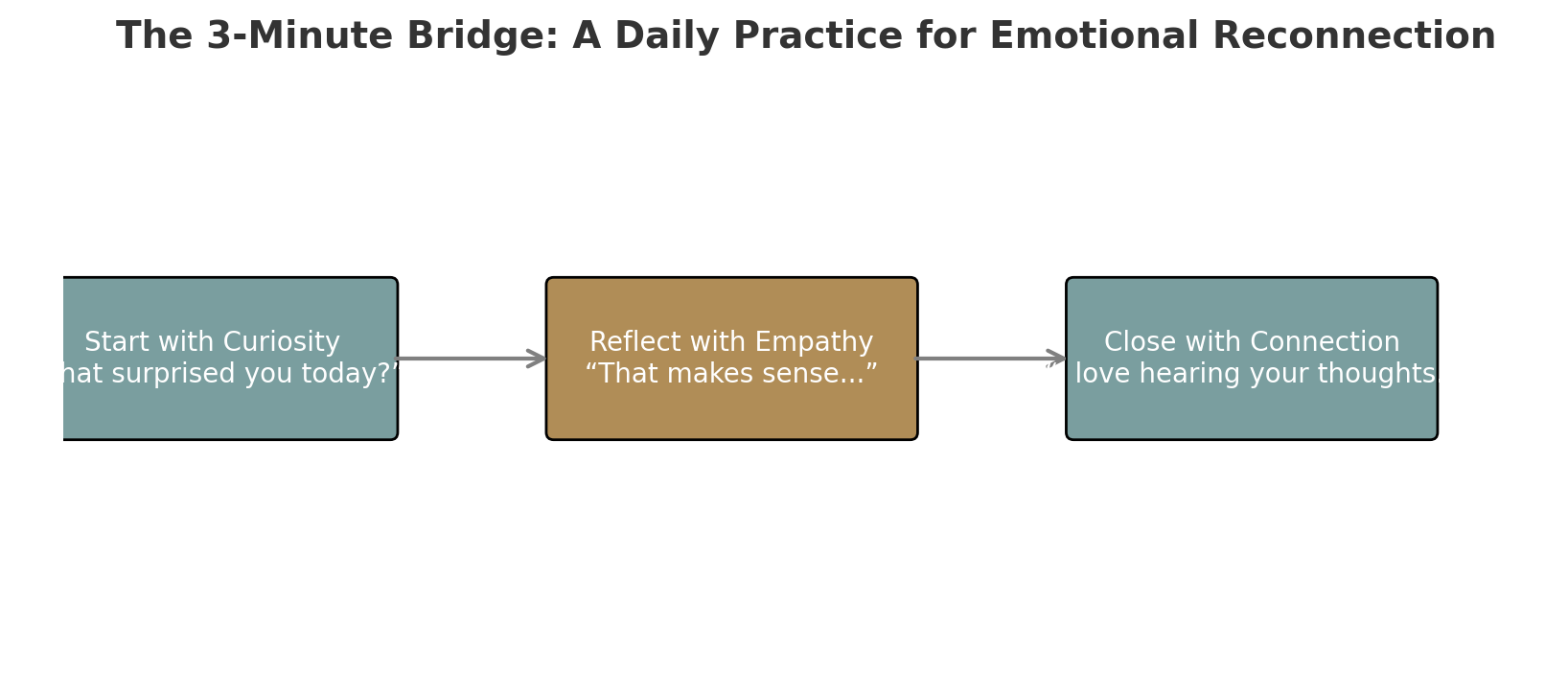
A repeatable script for reconnecting emotionally with your child in under five minutes a day.
7 Practical Strategies to Reconnect Before It’s Too Late
These aren’t feel-good fluff tactics. These are real-world tools for real-world parents.
1. Use “Shoulder-to-Shoulder” Time
Most kids (especially boys) open up more during parallel activity (walking, driving, doing a project) than face-to-face sit-downs.
2. Create a Sacred Weekly Check-In
Pick one hour every week—phones away, no agenda. Let them talk. Or sit in silence. The ritual matters more than the result.
3. Ask “Starter” Questions That Don’t Threaten
Try:
-
“What made you laugh this week?”
-
“What’s something you wish adults understood?”
-
“If you had $1M to spend only on fun—what would you buy?”
4. Invite Them Into Your World
Let them help you cook. Sit in on a call. Watch you fix something. You don’t always need to enter their world—bring them into yours.
5. Apologize Authentically
Don’t make excuses. Just say: “I think I’ve been too distracted. I’d like to do better. Will you help me reconnect?”
6. Celebrate Who They Are, Not Just What They Do
Kids feel deeply seen when praised for character, not just performance:
“I noticed how kind you were with your sister today.”
7. Protect the Relationship Like You Would a Business Deal
You calendar client meetings. You prep for pitches. Give your kid the same intentionality. You don’t need to be perfect—just present.
💬 “It’s not about parenting harder. It’s about parenting more honestly.”
Kids don’t stop needing you all at once.
They stop trying when you stop showing up.
When to Get Help—And Where to Start
If your child is avoiding you, lashing out, or emotionally walled off, you don’t have to figure this out alone.
-
Hire a parent-child reconnection expert to develop a step-by-step plan
-
Apply for a private retreat or coaching intensive designed for high-performing parents
-
Get a quote for family therapy that specializes in teens and communication breakdown
📥 Download suggestion: Get the Reconnection Blueprint—free checklist, daily micro-rituals, and a 3-minute script that works.
Conclusion: You Still Have Time—But Not Forever
One day, they’ll stop needing you the way they do now.
But that day hasn’t come yet.
You don’t need to overhaul your life. You just need to change direction.
-
From multitasking to presence.
-
From managing behavior to building trust.
-
From reacting to reconnecting.
✅ Get your personalized reconnection plan now.
✅ Speak with a parent-child coach who understands high-performing families.
✅ Start building rituals today that your kid will remember for life.
Because when your kids know they can come to you—you’ve already won.